


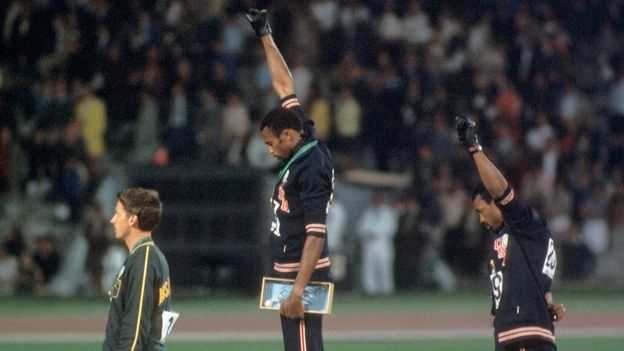

US athlete Tommie Smith attained international fame when he gave the Black Power salute at the 1968 Mexico City Olympics, 55 years ago. But as the exclusive BBC Archive clips in this new series reveal, that protest came at a heavy cost.

On 16 October 1968, two black US athletes – Tommie Smith and John Carlos – stood on the podium at the Mexico City Olympics, heads bowed. They wore black socks with no shoes; Smith wore a black scarf around his neck. As the US national anthem played, they each raised a black-gloved hand in silent protest.
More like this:
– One of the US’s biggest mysteries
– The hit song that has divided the US
– An inside look at the real Rupert Murdoch
Although no words were spoken, the moment was full of meaning. Smith, who had won gold in the 200m, setting a new world record, raised his right fist to represent Black Power. Bronze medallist Carlos, wearing a bead necklace to symbolise the lynchings of black Americans, raised his left fist to represent black unity. The scarf stood for black pride and the socks with no shoes represented African-American poverty.
In History
In History is a series which uses the BBC’s unique audio and video archive to explore historical events that still resonate today
The Black Power salute, as it came to be known, was a defiant statement against the systemic oppression of black people in the US and marked a defining moment in the history of civil rights activism. But their use of it on 16 October 1968 came at great personal cost to the athletes involved. Within hours, they were condemned by the International Olympic Committee. Two days later, they were suspended from the US team and sent home. And as these exclusive BBC archive clips show, Smith paid a heavy price – both personally and professionally – in the years to come.
