



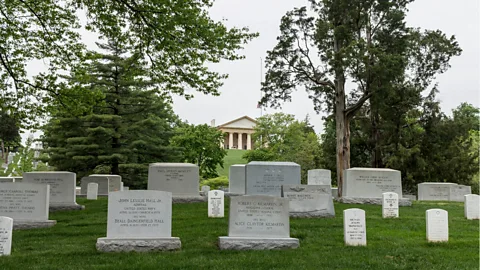
Two and a half miles away at the Black Heritage Museum of Arlington, Queen City’s little-known story is highlighted through photos and artefacts. According to Dr Scott Taylor, a third-generation Arlingtonian and the museum’s president, the lost “city’s” story starts at Arlington House, the Neoclassical mansion established in the early 1800s by George Washington Parke Custis, the step-grandson of Martha Washington who was raised by George and Martha Washington. Enslaved individuals from George Washington’s estate, Mount Vernon, built Arlington House before working on the property and in the home. General Robert E Lee, who in 1831 married Mary Custis, heiress of Arlington House, lived here in the years leading up to the US Civil War. After joining the Confederacy, Lee left, never to return. (After many years of focusing on the Custis-Lee story, Arlington House recently has been reimagined to encompass the voices of African Americans who lived and laboured there, too.)

 Alamy
AlamyAfter the Emancipation Proclamation of 1 January 1863 freed enslaved people in Confederate states, the federal government established Freedman’s Village on the Arlington House property (which would later become Arlington National Cemetery). The planned community, with clapboard houses, schools, churches and roads, became a thriving village for formerly enslaved workers. Reformer and writer Frederick Douglass often visited; and abolitionist Sojourner Truth, who lived in the village for a year and a half beginning in 1864, advised villagers on their rights.
At that time, “Arlington was 75% to 80% Black,” Taylor said. “There was so much Black activity then. People were learning to read and write. They were buying property, starting businesses. John Syphax [an African American politician born free in Virginia] became a delegate. This scared [white] people – that’s why [the federal government closed] Freedman’s Village.”
By 1900, the thriving village had been dismantled, with few home and business owners fairly compensated. Today, little remains, other than a historical plaque in Foxcroft Heights Park overlooking Arlington National Cemetery, near its original location.
