


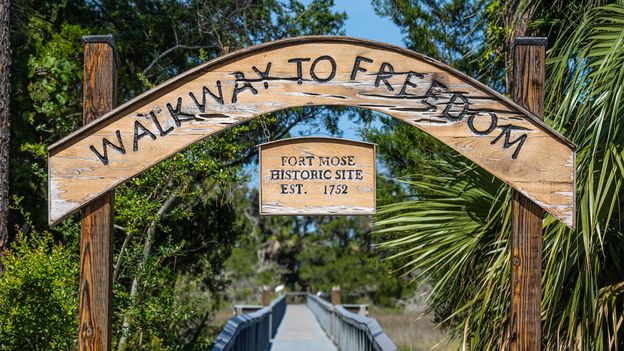

Nearly 200 years before slavery was abolished in the US, Black freedom-seekers journeyed south instead of north to a place that promised freedom.

In October 1687, a dugout canoe arrived at the shores of St Augustine, then a settlement in Spanish Florida and now the oldest continuously occupied city in the mainland US. The canoe carried eight men and two women, one of whom was holding a toddler in her arms. The travellers were Black fugitives who had escaped enslavement by British plantation owners in the Carolinas to the north. After disembarking from their vessel, they headed to the town centre in search of freedom.
“They went to present themselves to the governor of St Augustine,” said Jane Landers, a professor of history at Vanderbilt University and a director of Slave Societies Digital Archive, which documents the history of enslaved Africans and their descendants. “They explained that they are asking for his protection, and that they wanted to become Catholics.”
The group of travellers had heard that this Spanish settlement was set to become a religious sanctuary and would offer freedom to any previously enslaved person willing to convert to Catholicism. Soon, other enslaved Black people from Georgia and the Carolinas in British Colonies up north began to escape south to St Augustine.
The journey toward freedom could take a week or more and was perilous. The escapees navigated swamps and coastal waters that were full of dangers. In the wilderness, alligators, panthers and poisonous snakes awaited. In towns and villages, slave catchers prowled the streets. The sun was relentless, as were the mosquitos, and it was often difficult to find food and water. Still, for many, the promise of freedom was worth the risk. Sometimes, the local Yamassee Native Americans who lived in Georgia and the Carolinas even helped the fugitives, essentially creating an early Underground Railroad that ran south instead of north.
