



Many outlets dedicated to serving Black communities see their roles as multifaceted. They must capture the history Harris could make if she, a Black woman of Indian and Jamaican descent, becomes the first female president — even as Harris herself has steered clear of focusing on her identity. Plus they must clearly articulate what a Harris, and Trump, presidency would mean for Black communities, with context and nuance. That approach builds on the tradition of Black news outlets, which were created in an absence of Black perspectives in mainstream, white-led publications.
Black media “plays a unique role in not just, ‘This happened today, that happened today,’ but how does this relate to the longer period of America, broadly, and the Black American experience,” said Cheryl Thompson-Morton, director of the City University of New York’s Black Media Initiative.
Black news outlets in the United States, which date back to the early 1800s, have a long, proud history of advocating for desegregation, racial justice, and voting rights.
For many Black publications, that advocacy for their communities continues today through hard-hitting journalism. In its mission statement on election coverage, Capital B said: “Too often, mainstream newsrooms gloss over or ignore what issues matter to Black communities. . . . We aim to correct these oversights and omissions.”
Black-owned publications such as The Bay State Banner in Boston build upon the Black press tradition of acknowledging “the history that we represent to our people as a representation of their true value, worth, image, and respect,” said Ronald Mitchell, the Banner’s co-owner, editor, and publisher. That’s in contrast to how mainstream publications historically portrayed Black people with stereotypes or derogatory images, he said.
In a recent column urging Black men to support Harris, Mitchell touted her policy proposals to support Black entrepreneurs and criticized Trump “and his white supremacist political allies.”
“What exactly, explicitly did he do for Black people? For Black men?” Mitchell wrote. “Okay, some additional funding for historically Black colleges and universities. That’s about it, and that’s a traditional token move by Republican administrations going way back.”
The Bay State Banner endorsed Harris in a recent editorial, and Word in Black, which is made up of 10 Black-led publications, including New York Amsterdam News, endorsed Harris in July. Essence and Capital B have not endorsed.
For the Banner and other Black publications, carrying on the tradition of the Black press includes covering Harris fairly while also highlighting the historic moment if Harris wins, even when she is not spotlighting it as much relative to Hillary Clinton’s “I’m with her” feminist-focused, but unsuccessful, messaging.

“It can’t be lost on a legacy publication like Essence to capture the historic nature of the campaign,” said Melissa Noel, contributing editor for news and politics at Essence, a magazine that has catered to Black women since 1970. “We know that this is monumental.”
Noel said the outlet has prioritized stories such as what Harris’s presidency would mean for Black women and her “opportunity economy” plan’s impacts on Black women and people of color. The magazine has also covered the history that Harris is making and her journey, including photos of her growing up.
At Capital B, Virella touted the outlet’s “Black Political Power Tour,” where reporters traveled to Philadelphia, Phoenix, and other cities to connect with voters and its coverage of the campaigns’ outreach to Black voters across the country. One story delved into how Harris and running mate Minnesota Governor Tim Walz visited Savannah, Ga., for the first presidential campaign visit since the 1990s. Black rural Georgians told Capital B that they “feel seen” by the campaign following the visit.
“That story really hit hard with our audience,” Virella said.
During this election, many Black news outlets have also aimed to highlight divisions within their communities in a sensitive, nuanced way.
While most Black Americans support Harris — a recent New York Times/Siena College poll found 78 percent of likely Black voters plan to cast ballots for her — there are others who do not. Some Black voters, including a portion of younger people, see Harris as not progressive enough. Others embrace Trump.
Recently, mainstream news outlets seized on that poll, which also showed only 70 percent of Black men supported Harris, a decline from the 85 percent favoring Biden in 2020.
Aaron Foley, news editor at the New York Amsterdam News — one of the country’s oldest Black newspapers — said Black news outlets have the imperative to avoid over-generalizations and frame statistics within proper context. That includes not running headlines that overstate the recent polling, he said, such as, hypothetically, “Black men are skeptical about having a Black woman in office.”
“That would be taken and run with this saying, ‘Oh, here’s a Black paper saying all Black men are doing it,’ ” Foley said.
Many Black outlets instead have run articles reframing the conversation, such as Capital B’s story: “What Headlines Miss About Black Men’s Support for Harris,” which acknowledges the drop in polling, but emphasizes that Black men are poised to be the second-most-supportive voting bloc for Harris after Black women.

The election comes at a time when both the Trump and Harris campaigns are leaning heavily into alternative media, betting that podcasts and influencers can better reach uncommitted voters than established outlets. In recent weeks, Harris has spoken to Black media personalities such as radio host Charlamagne tha God and the hosts of podcasts such as “All the Smoke” to reach potential Black voters, particularly younger ones, who don’t typically tune into political news.
Some outlets understand that strategy, but still believe it’s important for Harris to speak with Black journalists at Black news outlets to make commitments to their audiences and answer questions important to Black voters.
“We recognize where we are in the landscape,” Foley said. “But we also would like to acknowledge our own legacy as being one of the oldest Black newspapers in the country . . . and we think it would be impactful if we could just get a moment of the candidate’s time.”
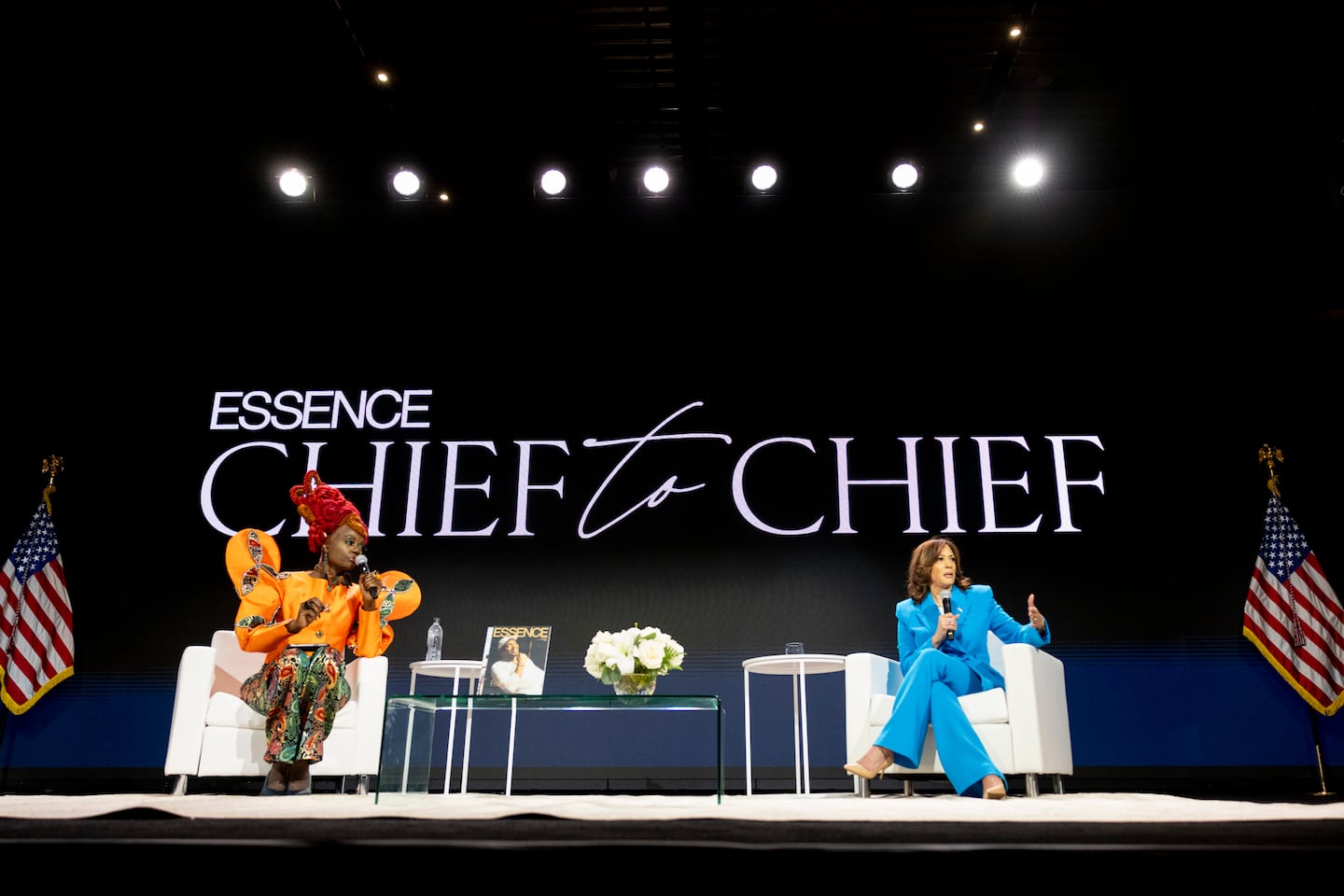
Harris did sit down in July with Essence CEO Caroline Wanga, who asked about the vice president’s upbringing, but also about Black maternal mortality and how Black women can exercise their power through Election Day.
“For over 50 years, Essence has been teaching this member of the human community called the Black woman that she has a power that just needs to be unleashed,” Wanga said. “Madam Vice President, you are speaking to the most powerful ballot community.”
“That’s right,” Harris responded, before urging Essence’s readers: “I don’t hear no. And don’t you hear no either.”
Aidan Ryan can be reached at aidan.ryan@globe.com. Follow him @aidanfitzryan.
