


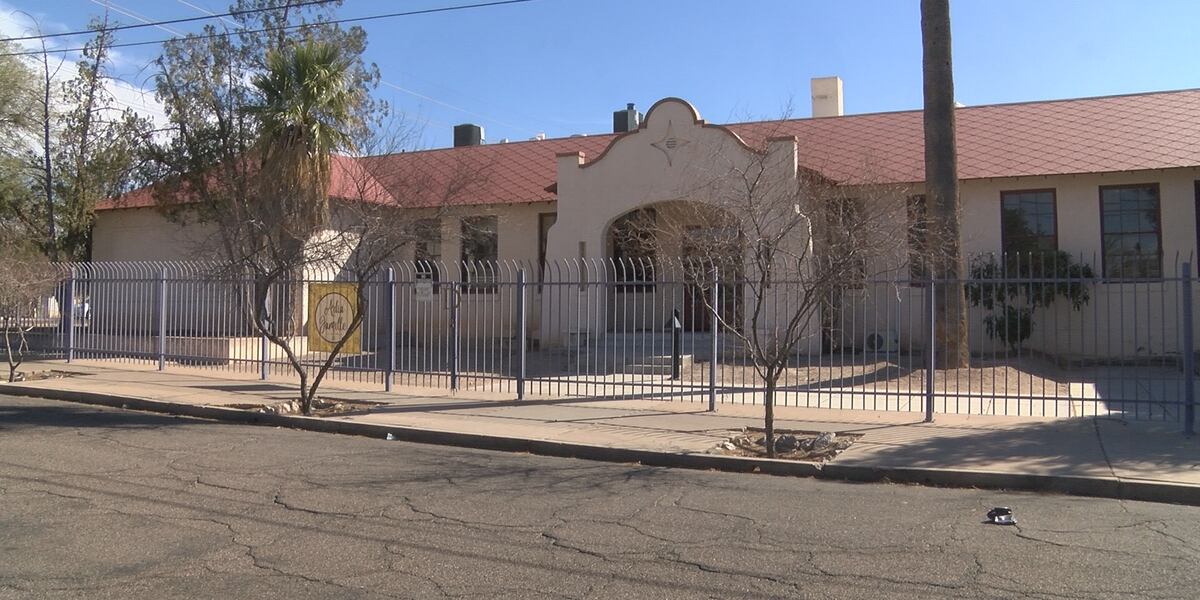

TUCSON, Ariz. (13 News) – The Dunbar Pavilion in Tucson was once the city’s oldest segregated elementary school.

Today, the more than 100-year-old building located at 325 West 2nd Street, serves as the center for several programs and resources that support Tucson’s African American community.
Classrooms are used as meeting spaces and the auditorium can be rented out for various gatherings.
While a lot of restoration work has been done to bring the historic building to where it is today, the work is not over yet.
Right now a portion of the Dunbar Pavilion, which was built in 1943, is being converted into what will become an empowerment center for local Black-owned businesses.
“Because the Black community is such a small percent in Tucson, this place has to remain a place of connection, a place of community,” said Dunbar Pavilion Executive Director Freda Marshall.
Marshall said the nonprofit was awarded a more than one-million-dollar federal grant to build the business empowerment center a few years ago. The city of Tucson is leading the project. Phase one to eliminate lead and asbestos from the structure is complete and construction will begin soon.
“We want people to get out of their trunks, we want people to get out of their closets if they’re ready to really launch their business,” Marshall said. “We want to serve as that hub, as that resource, for them to be able to do that.”
To understand the legacy and power the building possess you have to go back in time to understand its history.
Following statehood in 1912, the Arizona Constitution mandated that African American children attend segregated schools. Tucson’s first African American school, known only as the “Colored School,” established in 1913, was held in the back of the former Stonecypher Bakery at 215 E. 6th Street and was under the direction of principal Cicero Simmons. Today, the building is a marijuana dispensary.
By 1918, Tucson’s African American students were moved to the then newly-constructed Dunbar Laurence School off West 2nd Street. It served as the city’s only segregated school for more than 30 years.
In 1952, Dunbar School was integrated and renamed John Spring Junior High.
87-year-old Barbara Lewis works as the Dunbar Pavilion historian. Her passion for the former school is personal. She attended Dunbar from 1942 until 1950.
“I know we were deprived of a lot of things, but it was really happy years for me,” Lewis said.
Lewis said despite having used books and no library, cafeteria, auditorium or gymnasium; they had teachers that taught them to dream big.
“We had folks to show us that we could do almost anything,” Lewis said. “We didn’t think about ‘oh we’re segregated.’ I never remember having a thought ‘I sure would like to go to a school with white kids,’ that never occurred to me.”
It’s the love former students have for the school that has kept it standing. Lewis said at a class reunion in the 1980s, the Dunbar Coalition was made aware that their old school was falling apart and decided to buy it for $25.
“All the windows were broken, the plumbing was rusted, the electricity gone,” Lewis said. “What folks see now might not look like it’s all spiffy and up-to-date, but it’s millions in here.”
The alumni who saved the historic structure can now see its legacy live on through the next generation.
“Every day that we’re here we are making history in the now,” Marshall said. “And we will make history 10, 15 years down the line.”
Marshall said they hope to start construction on the new empowerment center in the spring with a goal of completion by the fall of this year.
The nonprofit relies on grants and donations to keep the lights on. Marshall said they are constantly looking for funding to improve all aspects of the aging center. Along with the new business center, she said there are additional classrooms they are hoping to renovate.
If you are interested in donating to the Dunbar Pavilion, visit their website.
Be sure to subscribe to the 13 News YouTube channel: www.youtube.com/@13newskold
