


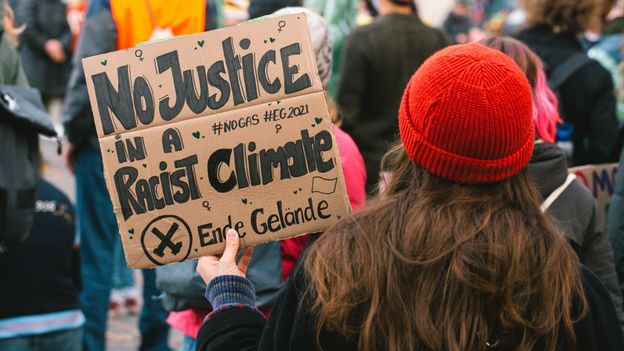

Even though some exploitative practices may be in the past, the legacy of their unjust structures remains, and carries through into decision-making about climate change today, he says. “Ultimately our economic system has at its core this notion that in the pursuit of capital accumulation and profit, some people can be sacrificed, and that has overwhelmingly been people in the Global South,” he says. “So we have to understand the connection between slavery, colonialism and racialised capitalism, which creates the conditions for the climate crisis.”

The anthropologist Jason Hickel also makes this colonial connection. As part of his work on global inequality, he has studied responsibility for climate change between the Global North (the US, Canada, Europe, Australia, New Zealand, Israel and Japan) and the Global South (Latin America, Africa and Asia). “Our study calculated how much each nation has exceeded their fair share of the ‘safe’ planetary boundary for CO2 emissions,” he says. The results are “staggering”, he says: the study found the Global North is responsible for 92% of all excess global emissions, while the Global South is responsible for only 8%.
“The nations of the Global North have effectively colonised the atmospheric commons. They’ve enriched themselves as a result, but with devastating consequences for the rest of the world and for all of life on Earth.”
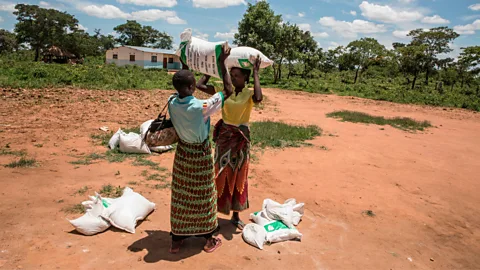 Guillem Sartorio / Getty
It is the countries of the Global North that industrialised first, and here that the power base of the fossil fuel corporations emerged. Here is where energy use and resource consumption are highest – and therefore where carbon footprints are largest. People drive and fly, often eat more meat and dairy, and have fridges and gas boilers in their homes. These are countries with majority white populations. Conversely, the countries with the lowest emissions are mainly across sub-Saharan Africa and South and East Asia, with majority black and brown populations. Even accounting for the huge emissions from China, which are relatively recent, white people have had a greater cumulative impact on the climate.
